Your AI can read your documentation. But does it understand it?
Imagine documenting a software product with 50,000 topics. AI can search them, summarize them, and write new content. But can it understand how everything is connected, or determine what happens when a product requirement changes?
Giving an AI agent more documentation is not always the answer. Every model has a finite context window, measured in tokens. As that window fills, relevant facts compete with everything else for the model's attention. More context can make an agent less accurate, not more informed. This degradation is often called context rot.
The better approach is discrete, specific context: the facts and content needed for the task, the dependencies that connect them, and the evidence behind them. Give your AI what matters, not everything you have.
Finding information and understanding its relationships are different problems.
Vector search: finding related information.
An engineer announces a change to authentication. Traditional search can find terms such as authentication, credentials, and login. Vector search goes further: it identifies semantically related topics even when they use different terminology.
It might discover installation guides, security documentation, API references, and troubleshooting procedures. That is powerful, but similarity is not necessarily dependency.
A document can discuss authentication without being affected by the change. Conversely, a procedure might depend on the changed mechanism without mentioning it explicitly.
Vector search discovers what looks relevant. It does not inherently establish what is affected.
Vector search is built in. The value goes beyond the match.
Pelcrow includes vector search, but finding a similar passage is only the start. Semantic search finds candidates; product and version context narrows them; explicit dependencies and provenance explain how they relate to the task.
You can assemble those capabilities yourself. The ongoing work is connecting retrieval to the documentation lifecycle: the facts writers reuse, the metadata they maintain, the sources behind claims, and the checks applied to changes. Pelcrow brings those pieces into one documentation system instead of leaving your team to build and maintain the connections between separate tools.
Your AI has less irrelevant material to sort through and more evidence for choosing the right content. Discover broadly. Ground precisely.
Taxonomy-driven search: finding the right information.
Enterprise search can go considerably further than keywords or vectors alone. Structured metadata, taxonomies, collections, and filters identify content for particular products, versions, features, and audiences.
For example, an Elasticsearch implementation can distinguish authentication documentation for one product and version from documentation for another. Sophisticated enterprise search can perform this filtering extremely well. This is not a limitation of search technology.
The challenge is building and maintaining that intelligence. Taxonomies must be designed. Metadata must be populated and governed. Product and version relationships must stay current as documentation changes.
Even after finding exactly the right collection, a question remains: which documents actually depend on the changed authentication mechanism, and where do those dependencies lead?
Taxonomy establishes the right context. It does not inherently describe every relationship within it.
The right answer must also be right for this product and version.
A perfectly written procedure for the wrong release is still the wrong answer. Pelcrow brings applicability and governed metadata into the same system as content, reuse, and validation, so product and version boundaries are not left for the model to infer from prose.
Combined with semantic discovery, metadata-based filtering gives your AI a more relevant evidence set before it starts reasoning. Less cross-product confusion. Fewer opportunities to mistake an old procedure for a current one.
Knowledge graph: understanding what is connected.
Think of documentation as an interconnected system rather than a collection of files. A knowledge graph can explicitly model the relationships that prose alone leaves your AI to reconstruct.
- Product facts
- Which features a product supports, and from which version.
- Documentation elements
- Paragraphs, procedures, tables, topics, and reusable fragments.
- Dependencies
- Which topic or procedure depends on another element.
- Applicability
- Which products, versions, and audiences an element applies to.
- Provenance
- The approved specification or source behind a statement.
- Publications
- Where content is reused and which deliverables contain it.
Instead of knowing only that two documents discuss authentication, we can establish that an installation procedure depends on a specific product requirement. We can trace where that procedure is reused, which publications contain it, and where its underlying information originated.
A search engine can find occurrences of a reusable security warning. A graph represents the reuse relationship directly, so those connections do not have to be rediscovered from the text every time.
A knowledge graph moves us from finding documents that look related to understanding how information is connected.
But understanding relationships is only part of the problem. What happens when something changes?
Give your AI the connections, not another inference problem.
Pelcrow connects documentation elements to their sources, reuse relationships, and publications. Your AI does not have to rediscover those declared connections from similar wording every time it works on a topic.
Search finds the passage. Taxonomy establishes its scope. The graph supplies the surrounding relationships. Graph-organized context helps bring the bigger picture into view. The result is context that explains what belongs together and why, supporting more complete, better-grounded edits.
Digital twin: understanding the consequences.
In engineering and manufacturing, digital twins represent real systems and the relationships between their components. They help evaluate how changes may affect those systems. Pelcrow applies this concept to enterprise documentation.
Its digital twin is designed to represent product facts, documentation elements, dependencies, applicability, provenance, and publication relationships. Declared dependency rules turn those connections into explainable change impact.
Suppose engineering changes an authentication mechanism. The goal is to identify the underlying requirement, trace dependent documentation, find every reuse and publication, and exclude content outside the applicable relationships.
Illustrative impact assessment
Procedures or requirements directly affected by the changed mechanism.
Why: a declared dependency connects them to the changed requirement.Related documentation with potential indirect dependencies.
Why: a connected element may be affected; a reviewer must confirm.Content outside the applicable product, version, or dependency relationships.
Why: it falls outside the declared scope of this change.More importantly, Pelcrow is designed to explain why each item was included. Instead of hundreds of documents that might be relevant, the goal is a precise, explainable set of affected content.
Your AI receives those bounded elements and their supporting evidence, allowing targeted edits without reconstructing the entire documentation system itself.
Not just which documents look relevant. Which documents are affected, and the evidence that explains why.
The assessment is only as complete as its modeled relationships and declared rules. Missing dependencies still need to be captured; a graph is not a substitute for maintaining the knowledge it represents.
Turn a change request into a bounded, explainable worklist.
Pelcrow's digital twin is designed to combine the graph with applicability and declared rules: what must change, what needs review, and what falls outside the change. Each inclusion should have a traceable reason, not just a similarity score.
Your AI gets specific content with supporting evidence it can check instead of an open-ended instruction to “update everything relevant.” A smaller, justified edit scope helps reduce missed dependencies and unnecessary changes, while keeping human review focused.
Why Pelcrow? Because AI memory is not enough.
Modern models can process enormous amounts of information, and their context windows keep growing. But reading the entire corpus is not the same as maintaining an authoritative understanding of how everything connects.
An AI might find an authentication requirement. Is it still current? Which versions does it apply to? Where is it reused? What depends on it? What happens when engineering changes it? A larger context window does not automatically maintain those relationships. Neither does conversational memory.
Less context to reconstruct. More evidence to act on.
Context rot describes the loss of reliable use of information as context grows noisy, stale, or overloaded. The answer is not simply to put more documents into the same prompt. It is to supply the right information, with its scope and evidence intact.
- Retrieve within a defined scope. Use product, version, and audience metadata to narrow context.
- Trace declared dependencies. Follow explicit relationships rather than relying on similarity alone.
- Ground facts in their sources. Preserve provenance so claims can be checked against supporting evidence.
- Send bounded elements. Give the AI the affected content and reasons, not an undifferentiated document dump.
- Validate the change. Check references, reuse, terminology, and governance rather than trusting memory.
These techniques reduce the burden on the model; they do not make it infallible or eliminate context limits. Your AI still reasons and writes. Pelcrow supplies the governed knowledge behind that work.
Organizations can build this infrastructure themselves with search engines, taxonomies, metadata, graph databases, dependency rules, and custom integrations. Many already have. The hard part is not acquiring those components. It is keeping them connected to the same content, applicability, reuse, provenance, and validation rules as products, versions, and repositories change.
Pelcrow is designed to provide that knowledge infrastructure as a unified system.
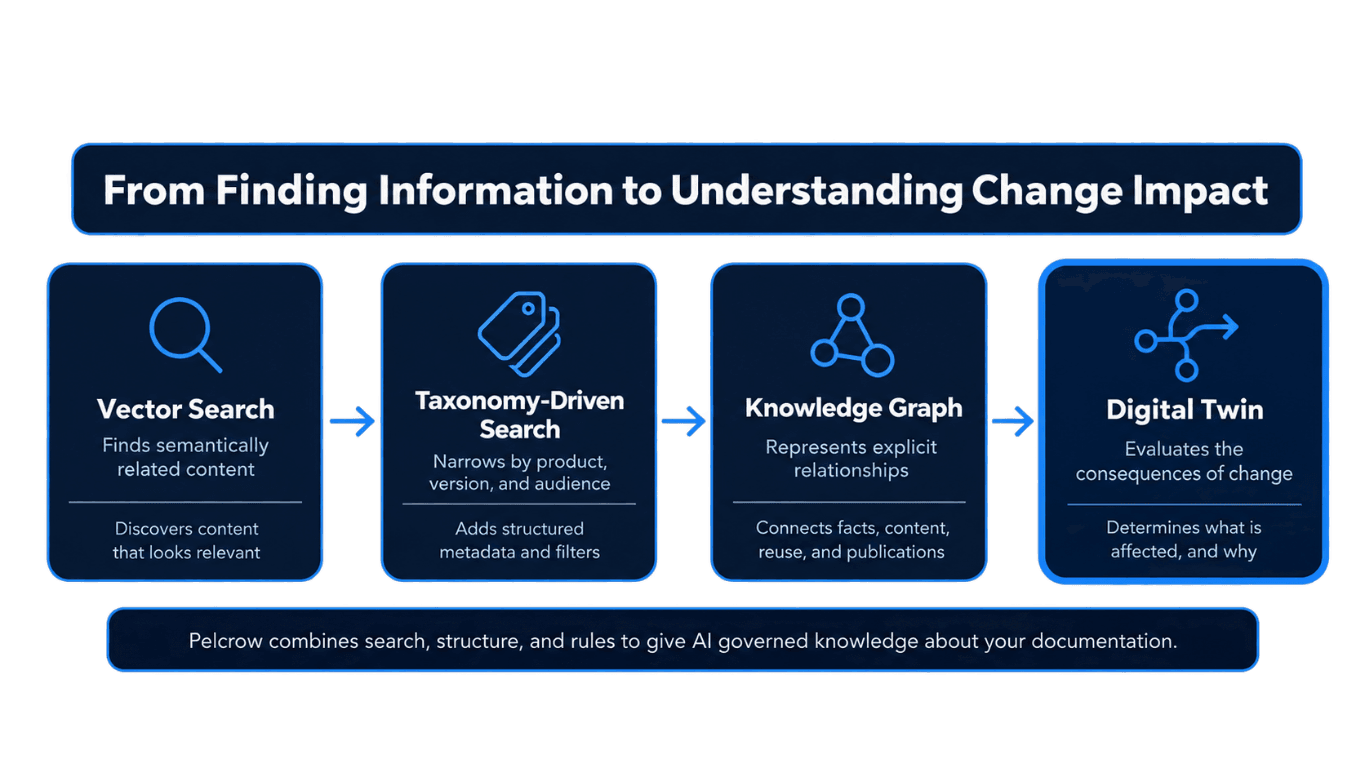
Vector search discovers potentially relevant content. Taxonomies establish context. Knowledge graphs represent relationships. Digital twin logic evaluates dependencies and the consequences of changes. Together, they give AI structured, governed knowledge about the content it works with.
More accuracy starts with better context, not just more memory.
Vector search, taxonomy, knowledge graph, and digital twin logic, brought together in Pelcrow: discovery, scope, relationships, and change-impact rules connected to the documentation workflow. Your team gets a unified system rather than another integration project. Each layer removes a different kind of guesswork before your AI writes.
A large context window does not guarantee reliable use of every fact inside it. The path to more accurate answers and edits is discrete, task-specific context, backed by sources and checked against the documentation system. Your model spends less effort reconstructing the knowledge and more effort doing the work.
The reference desk and fact-checker.
Not the writer.
Pelcrow helps your AI understand what already exists, what depends on what, and what needs to change. Keep your assistant. Give it a knowledge system worth relying on.