AI made docs easy to write.
Pelcrow makes them safe to scale.
Keep your Git. Keep your Markdown workflow. Keep the AI your engineers already use. Pelcrow adds the structure, memory, provenance, and governance that plain docs-as-code leaves behind.
Your AI writes. Pelcrow knows what already exists, tells it what to reuse, records where it came from, and checks what enters the documentation set.
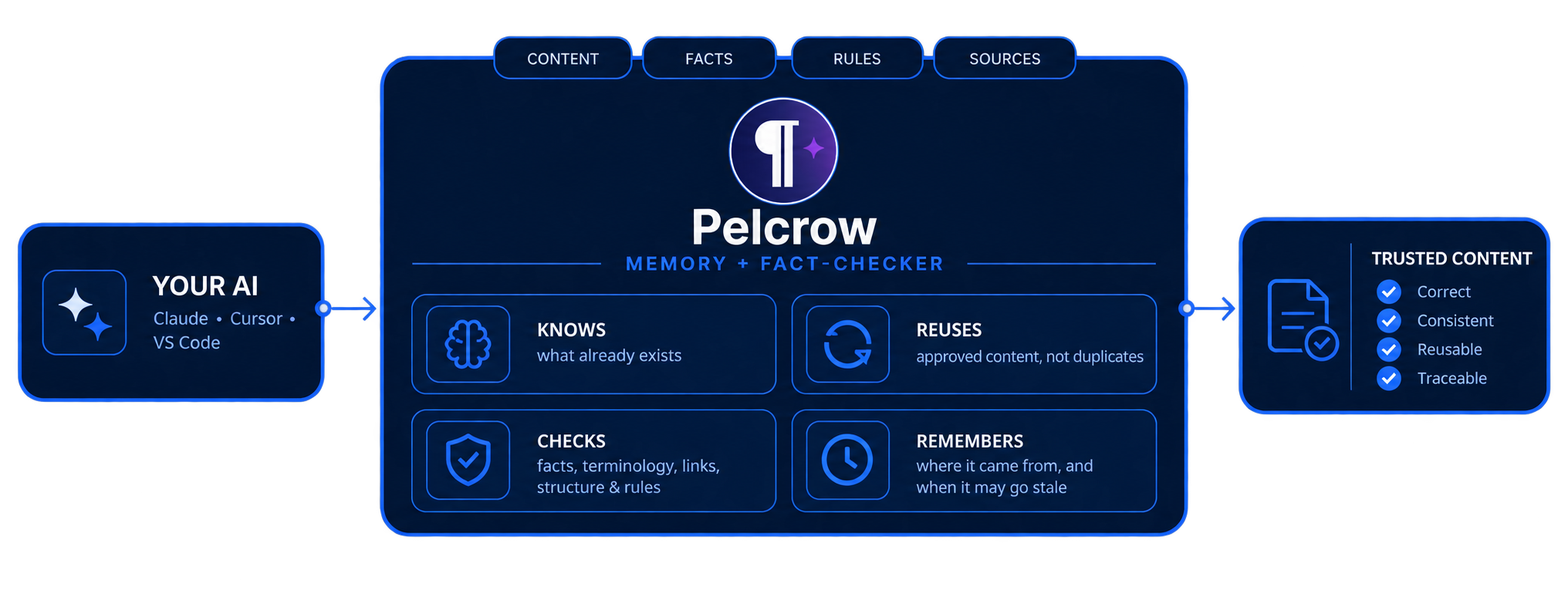
Writing was never the whole documentation problem.
AI can draft a technical document in minutes. So teams are moving documentation into Git, handing more of it to engineers, and replacing expensive authoring systems with Markdown and AI.
The writing still works. Everything around the writing starts disappearing.
Reuse disappears
The same procedure gets written five times instead of maintained once.
Terminology drifts
Product names, versions, URLs, and approved terms become independent strings scattered across the repo.
Variants split apart
Cloud and on-prem, Enterprise and Free become separate documents that slowly diverge.
Nobody knows what already exists
The AI writes another topic because it has no structured memory of the documentation set.
Nothing knows when it became stale
The source changed. The document still looks perfectly healthy.
Provenance disappears
Nobody can answer which ticket, specification, change, or decision caused a statement to exist.
None of these are writing problems. They are systems problems.
Pelcrow is the system around the writing.
Read why contradiction is the quiet cause of AI getting it wrong →Keep the workflow engineers want. Add the structure large documentation sets need.
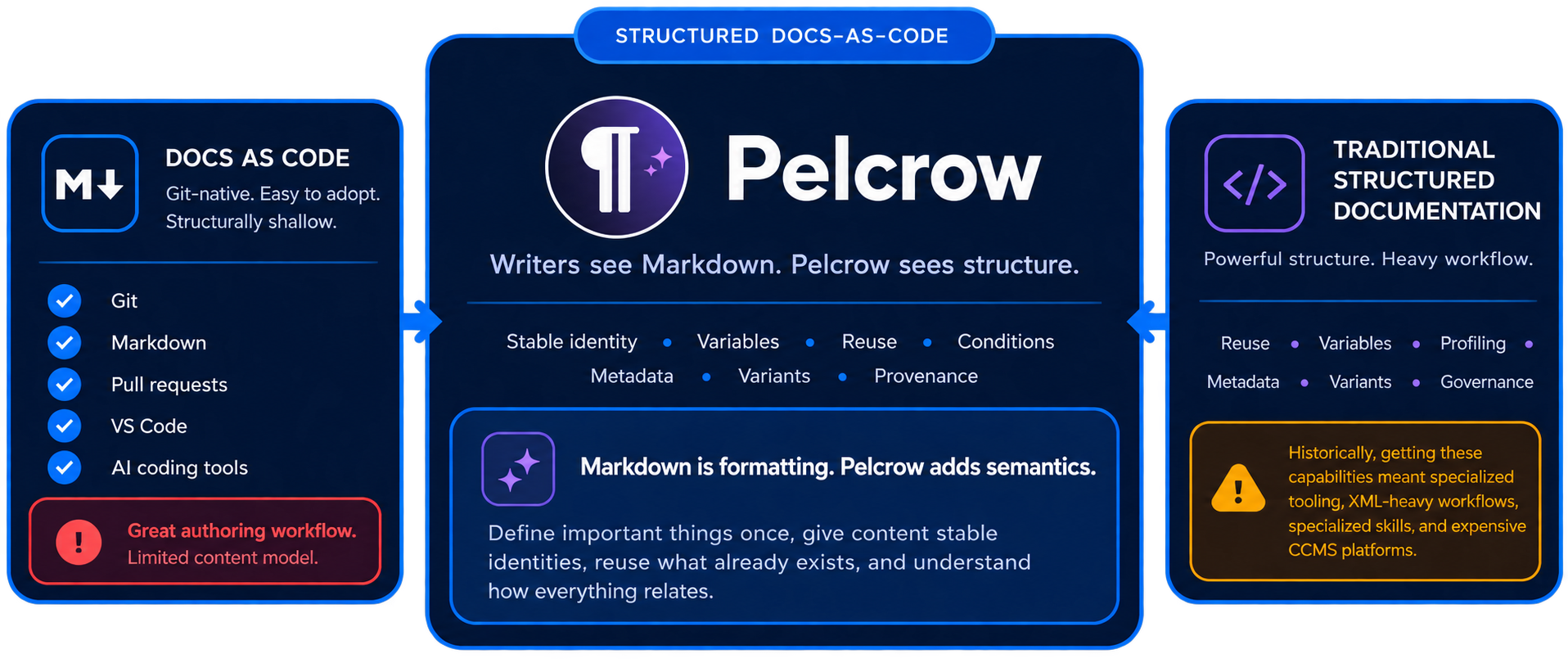
AI gives documentation a writer. Pelcrow gives it a memory.
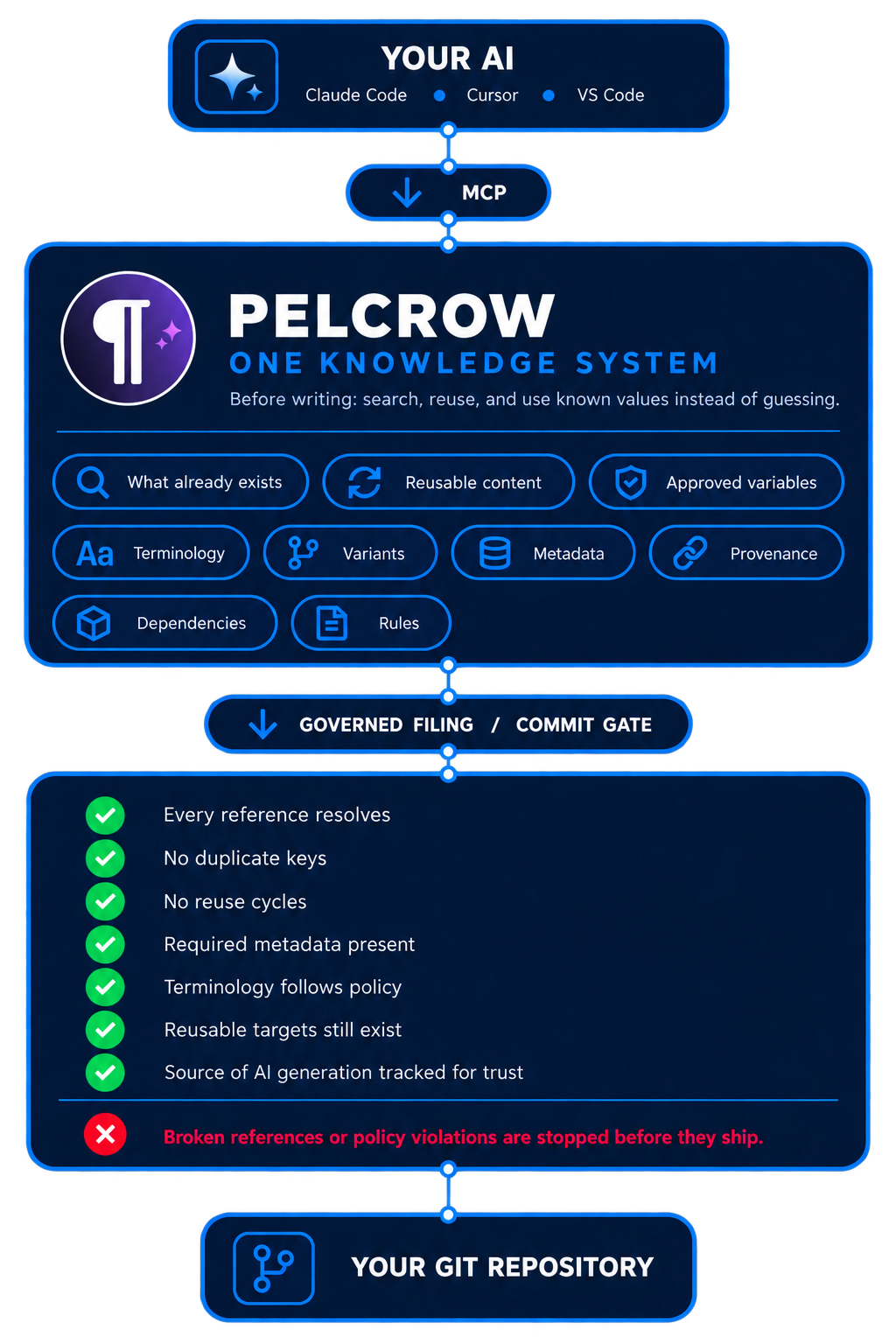
Pelcrow doesn't replace Claude Code, Cursor, VS Code, or the AI environment your organization already approved. It gives that AI a documentation system to consult.
Before writing
The AI can discover an existing topic instead of writing another one.
Pelcrow can return the approved reusable content and its stable identity.
Product names, versions, terminology, metadata, and variants come from the documentation system.
After writing
The same knowledge becomes the gate. Pelcrow checks structural integrity and policy again before the change enters the documentation set.
The protocol is standard. The knowledge behind it is not.
The AI is probabilistic. The documentation system cannot be.
Every document should be able to answer: Why does this say that?
AI-generated prose is easy. Trust is harder. Pelcrow keeps the documentation connected to the information and decisions that produced it.
Retention behavior changed
Provenance
Keep a record of the ticket, specification, commit, meeting, or other source associated with the document.
Dependencies
Documents, reusable content, variables, and references form a graph instead of a pile of unrelated files.
Staleness
When a source or shared dependency changes, Pelcrow can identify downstream documentation that may need review.
Pelcrow doesn't just store documentation. It preserves the reason the documentation exists.
That is the foundation for governing AI-authored content.
Explore governance & regulated documentation →Your terms, your style, enforced on every change.
Every team has rules: the product's real name, the terms you use, the ones you don't. Pelcrow checks every change against them the moment it's saved — so the wrong term or a typo never reaches published docs, no matter who wrote it.
One click when there's one right answer
Wrong casing, a deprecated term, a known typo — Pelcrow offers the exact fix. You accept it in a click.
Judgment stays yours
When wording is a real decision, Pelcrow flags it and leaves it to you. Nothing is ever silently rewritten.
Every writer, every agent, the same rules
Human or AI, the check runs at the gate. Consistency stops being something you police and becomes something you have.
It runs instantly, works offline, and costs nothing to run.
Your style guide finally enforces itself.
Your AI already knows how to write. Give it a documentation system worth writing into.
Pelcrow brings structure, memory, reuse, provenance, and governance back to docs-as-code — without taking Git, Markdown, or your AI away from the people doing the work.